Alps 2026 - A pilgrimage of effort, beauty, and open space
Marcin Formela
February 3, 2026
This is not a single region.
It is a continent in miniature.
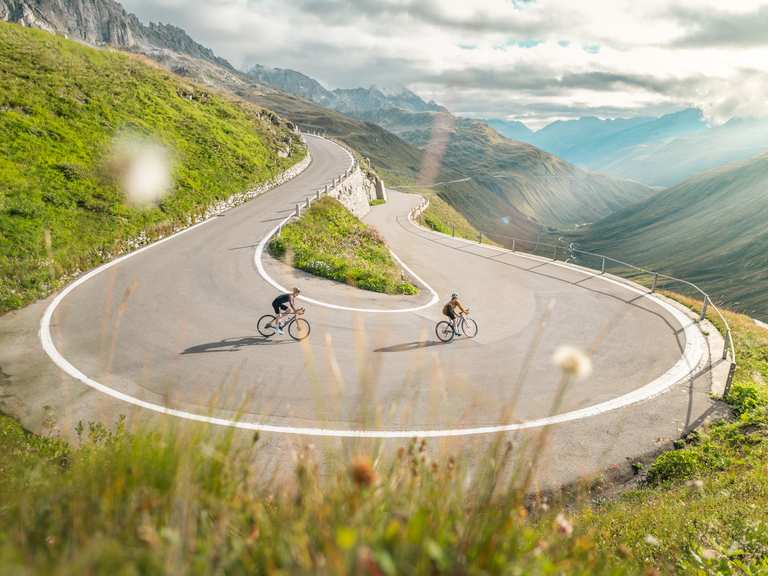
The route begins high in the Engadin valley, in Zernez, where raw alpine valleys meet protected wilderness. The first kilometers unfold through landscapes that feel like nature reserves for silence itself: wide meadows, pale spruce forests, glacial basins. Even here, the road starts to rise—over Ofenpass, then Umbrailpass—before revealing the first true icon: Stelvio. This is not just a climb; it is an entire mountainside carved into switchbacks, asphalt spiraling upward to nearly three thousand meters. From the summit, the world looks like a map: valleys reduced to thin lines, distant passes appearing as quiet promises on the horizon.
The descent into Merano brings the first dramatic contrast—from high-alpine austerity into almost Mediterranean softness: palm trees, historic promenades, a town that once served as a spa retreat for European aristocracy. Rest is brief. Ahead lie Timmelsjoch and Jaufenpass, long monumental crossings between Austria and Italy, where the road clings to ridgelines and a shift in wind can redefine the character of an entire ascent in minutes.
Then comes the heart of the Dolomites.
From Brixen, the route enters a labyrinth of Passo Erbe, Gardena, Sella, and Pordoi—a classic sequence where each summit feels like its own postcard. Here the rock is not gentle. Pale limestone towers rise vertically, jagged and severe, as if the mountains had been cut open with a blade. The road weaves between sheer walls, crosses open alpine pastures, then dives back into narrow valleys. Moena appears like an island of calm within this stone architecture—Ladin chalets, the Avisio river, and a wide open sky.
The next stretch is pure alpine theatre: Rolle, Valles, San Pellegrino, and Giau. The scenery changes every few kilometers. Dark spruce forests of Paneveggio give way to open high meadows, only to close again in tight valley corridors. Passo Giau rises like a natural stage—an immense, exposed bowl of grass and rock where everything is visible from afar: the road, the clouds, and your own fatigue.
Cortina d’Ampezzo enters the story as an elegant pause in this rugged narrative—a resort town framed by the spires of Tofane and Cristallo, carrying Olympic history and old alpine refinement. But soon the route returns to wildness: Passo Tre Croci and Tre Cime di Lavaredo. Three monumental limestone towers stand above alpine meadows like a roofless Gothic cathedral. The final kilometers toward Tre Cime are steep and concrete, enclosed by rock. It is one of those places where even non-cyclists instinctively fall silent.
Beyond the Dolomites, the landscape begins to change—subtly, but decisively. Lienz opens the door to the Carnic Alps, less famous and more severe. Gailbergpass and Plöckenpass follow, then the high-mountain Strada delle Vette and Monte Crostis: old military roads suspended along ridgelines, offering views that stretch endlessly. This is a different kind of beauty—less polished, more primal.
The climax of this section is Monte Zoncolan. A narrow road through dense forest, gradients that offer no mercy, and a silence broken only by your own breathing. It is a mountain that makes no attempt to be visually charming. It simply tests.
From there the route shifts eastward: through Paularo, Passo di Predil, Mangart Saddle, and the legendary Vršič Pass, whose stone-paved hairpins cut through the heart of Slovenia’s Triglav National Park. Here the Alps soften into greener tones, rivers turn turquoise, and valleys widen. Kranjska Gora and the area around Lake Bled introduce a gentler rhythm: mountain reflections in still water, wooden hayracks in open fields, and soft morning light.
The final act is a long passage over Bohinjsko Pass and a gradual descent toward the Adriatic. The mountains retreat slowly. Vineyards appear. The air grows warmer. The scent of the sea arrives. Trieste welcomes the group with a completely different energy—an old port city, Habsburg-era squares, and salty breeze drifting in from the Gulf of Trieste.
It is an extraordinary closing chapter: from glacial valleys in Switzerland all the way down to sea level.
⸻
This journey is not a collection of “beautiful climbs.”
It is a continuous transition between worlds: six national parks, dozens of mountain passes, tens of thousands of vertical meters, and a passage through four countries. Every day brings a new landscape, a new culture, a different quality of light.
There is no podium here. No general classification.
There is only the road, the mountains, and a sense of scale—from the highest alpine passes to the Adriatic coast.
This is not a vacation.
It is a full-length story about space.